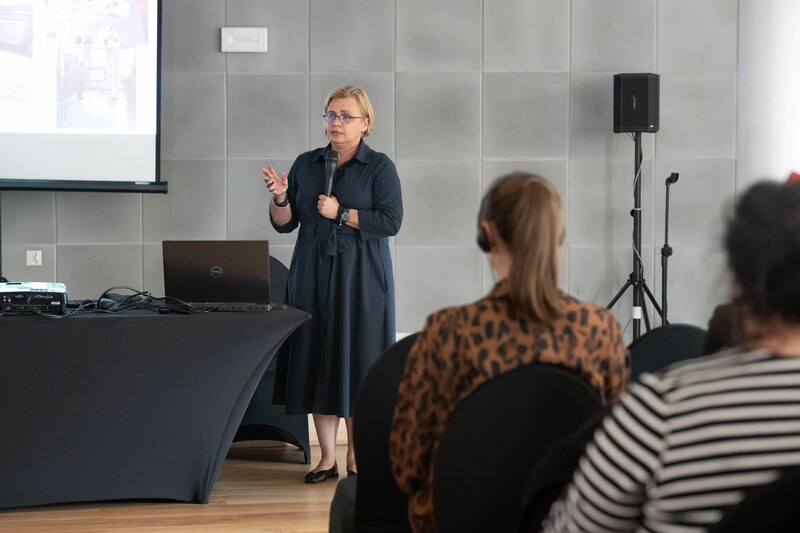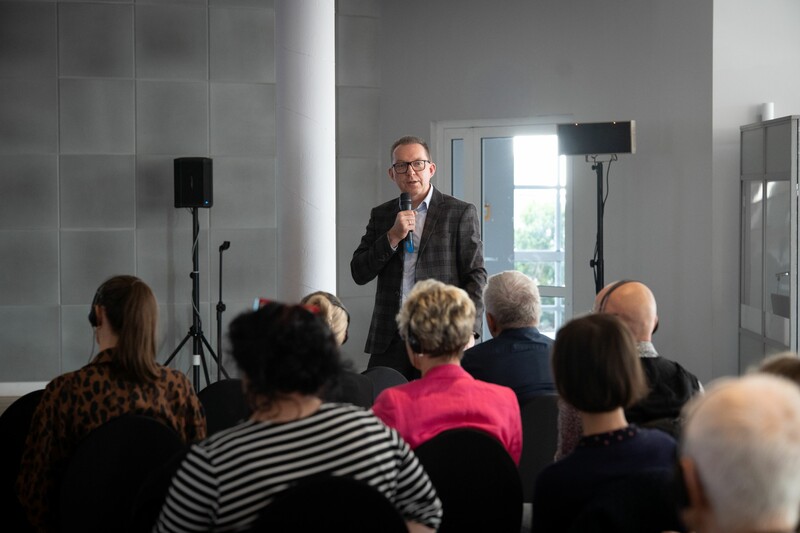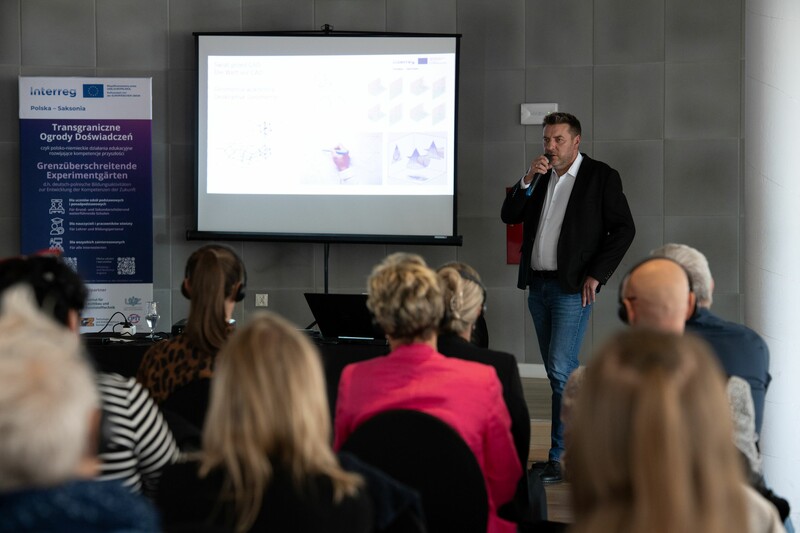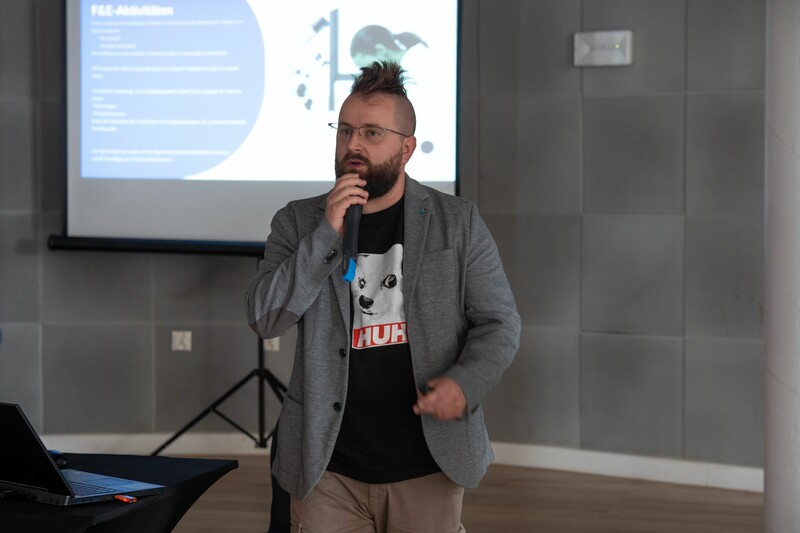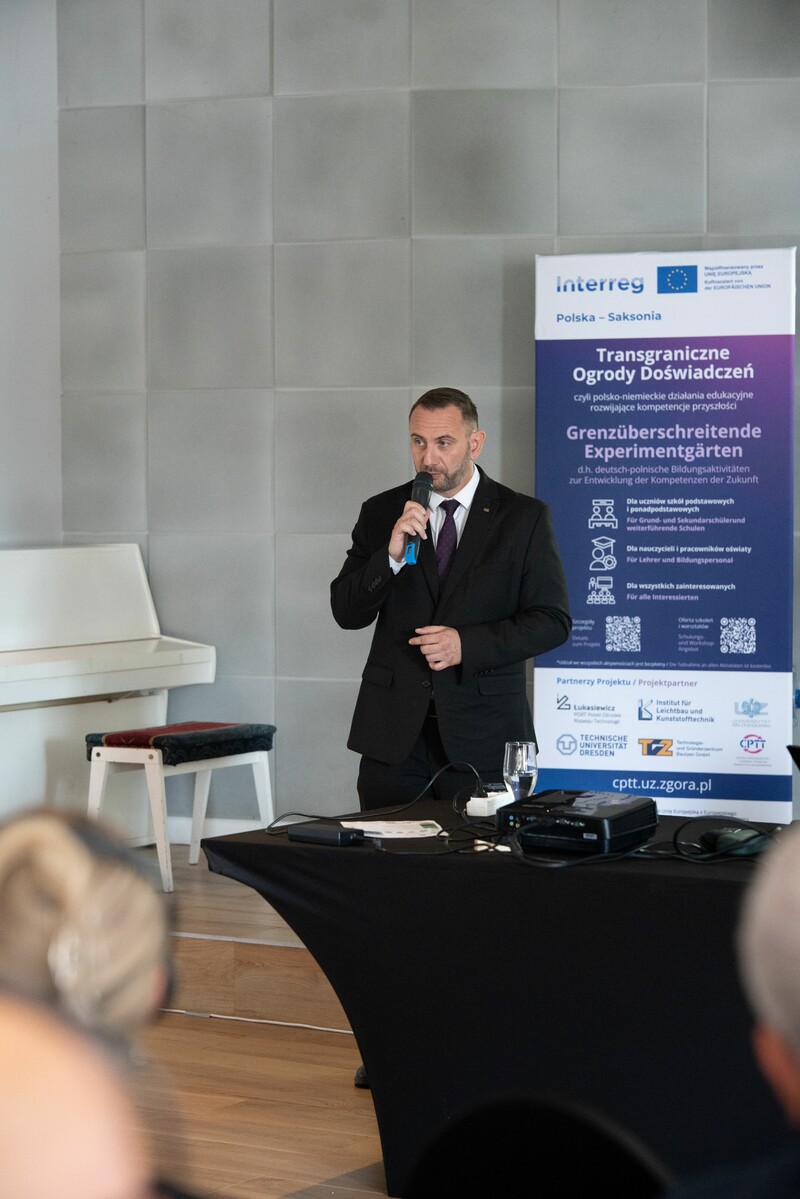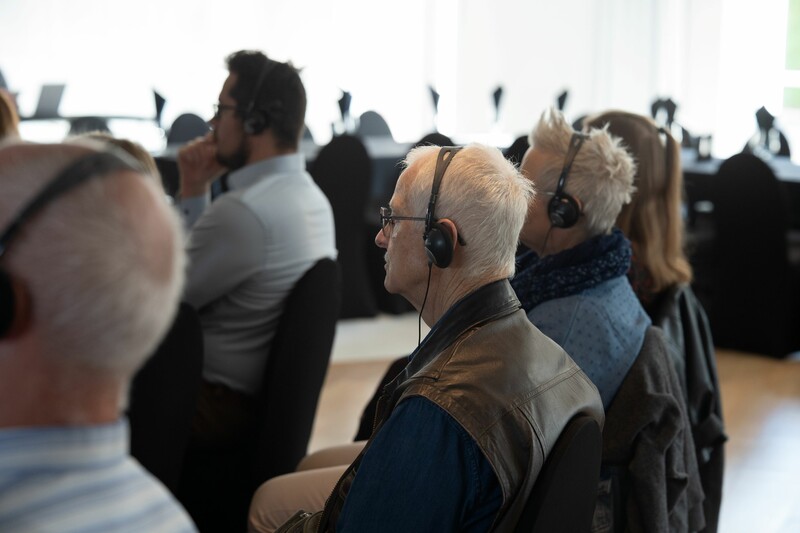

Another networking meeting was held in Łęknica as part of the “Cross-Border Gardens of Experience” project, this time under the theme “STEM in the Border Region: Gardens of Experience and Cooperation.” The event was attended by researchers from the University of Zielona Góra, who use elements of the STEM methodology in their work with young people on a daily basis.
The project is implemented by the Łukasiewicz Research Network – PORT Polish Center for Technology Development in Wrocław, the University of Zielona Góra, Dresden University of Technology and TGZ Bautzen GmbH. Its aim is to strengthen cooperation in the Polish-German border region, particularly by developing joint educational and research initiatives and fostering closer cooperation between academia and business.
During the meeting, staff from the University of Zielona Góra presented projects in which they use elements of the STEM methodology to convey knowledge to young people in an engaging and practical way.
One example of the practical application of this methodology is the Future Engineer Academy and Future Architect Academy, operating at the University of Zielona Góra since 2021. These initiatives bring together secondary school students, teachers, academic staff – not only from UZ – students of the University of Zielona Góra, and representatives of the socio-economic and regional environment. “In a very simple and accessible, but above all practical, way, we try to interest young people in the activities we carry out as part of the Academies. We present them through examples related to the world around us and try to explain the principles behind various technical solutions. We explain things that sometimes seem completely incomprehensible, yet are present in our everyday lives – such as using Google Maps, the internet or creating a website,” says Dr Anna Bazan-Krzywoszańska, Associate Professor at UZ, from the Institute of Architecture and Urban Planning at UZ.
Another example presented during the meeting was the Mathematical Modelling School, which can be regarded as a unique initiative in Poland. Its participants are students of the University of Zielona Góra, while students of Wrocław University of Science and Technology also joined the most recent edition. As Dr Maciej Niedziela, Professor at UZ from the Institute of Mathematics at UZ, emphasises, joint work by students from different academic centres produced very interesting results. “At first, the young people from the two centres approached each other with a certain degree of distance. However, the School showed that combining different experiences, knowledge and ways of working together can produce truly interesting results,” he says. According to Prof. Maciej Niedziela, mathematics does not have to be perceived as a difficult and abstract field. It can help us understand the world and solve real-life problems. “It is simply a matter of showing how we can use elements of mathematics to solve practical problems. Confronting a specific problem makes the difficult knowledge we struggle with at school suddenly become attractive,” he adds.
Dr Eng. Wojciech Babirecki from the UZ Centre for Entrepreneurship and Technology Transfer spoke about how new technologies can make workshops for young people and students more engaging. Information technologies, including the CAD systems he uses on a daily basis, make it possible to present a designed object in a practical way before it is physically manufactured. It can be viewed on a screen, examined from the inside, sectioned, have its movement simulated or its operation tested. Combining computer modelling with currently available, increasingly widespread and affordable 3D printing technologies makes it possible to quickly transform a virtual design into a real object. “I find this extremely appealing. For years, I have tried to conduct classes and encourage students to work in such a way that the experience is also interesting and engaging for them,” says Dr Eng. Wojciech Babirecki.
The meeting also addressed the topic of food technology, which combines many fields of science and allows them to be brought together around a common goal – producing safe and healthy food that meets consumer expectations and supports the health of future generations. “What we eat is extremely important for our health and quality of life. I see very broad opportunities for cooperation in the cross-border region, including the development of joint educational programmes for young people. The future is largely connected with food technology,” says Dr Eng. Jarosław Kliks from the Department of Human Nutrition and Diet Therapy at UZ. As he adds, cross-border cooperation is primarily about exchanging experience and knowledge, as well as providing opportunities to learn about technologies and good production practices operating on both sides of the border.
The “Cross-Border Gardens of Experience” project is now drawing to a close. All planned activities have been completed. In the near future, a closing conference and cross-border workshops for secondary schools will be held at the Łukasiewicz Research Network.
The participation of the University of Zielona Góra in the project is also an opportunity to demonstrate that the practical application of STEM methods is important not only in education, but also for entrepreneurs. “When a graduate of our University enters the workforce, they are not a ‘grey mouse’ in the company. They know how to communicate, how to work in a team, what reflection meetings are about, what project teams are and how to work in them. This practical knowledge that we provide our students with is an added value for companies, which can benefit from these competences,” says Karol Dąbrowski, Director of the UZ Centre for Entrepreneurship and Technology Transfer.
As he emphasises, one of the important objectives of the University's activities is to encourage young people to choose technical and science-based degree programmes and to build their professional futures in the region. “Above all, we want more young people to choose to study technical and science-based programmes at the University of Zielona Góra, which has the potential and experience to offer them. We have qualified staff as well as appropriate scientific and educational resources. We want students to stay here, choose to work in the region, and also live and develop here,” he adds.
The “Cross-Border Gardens of Experience” project demonstrates that science, education and cooperation with the wider community can be effectively brought together through practical activities. This is particularly important in a border region, where the exchange of experience and joint initiatives can provide a foundation for further projects involving school students, university students, researchers and entrepreneurs.